
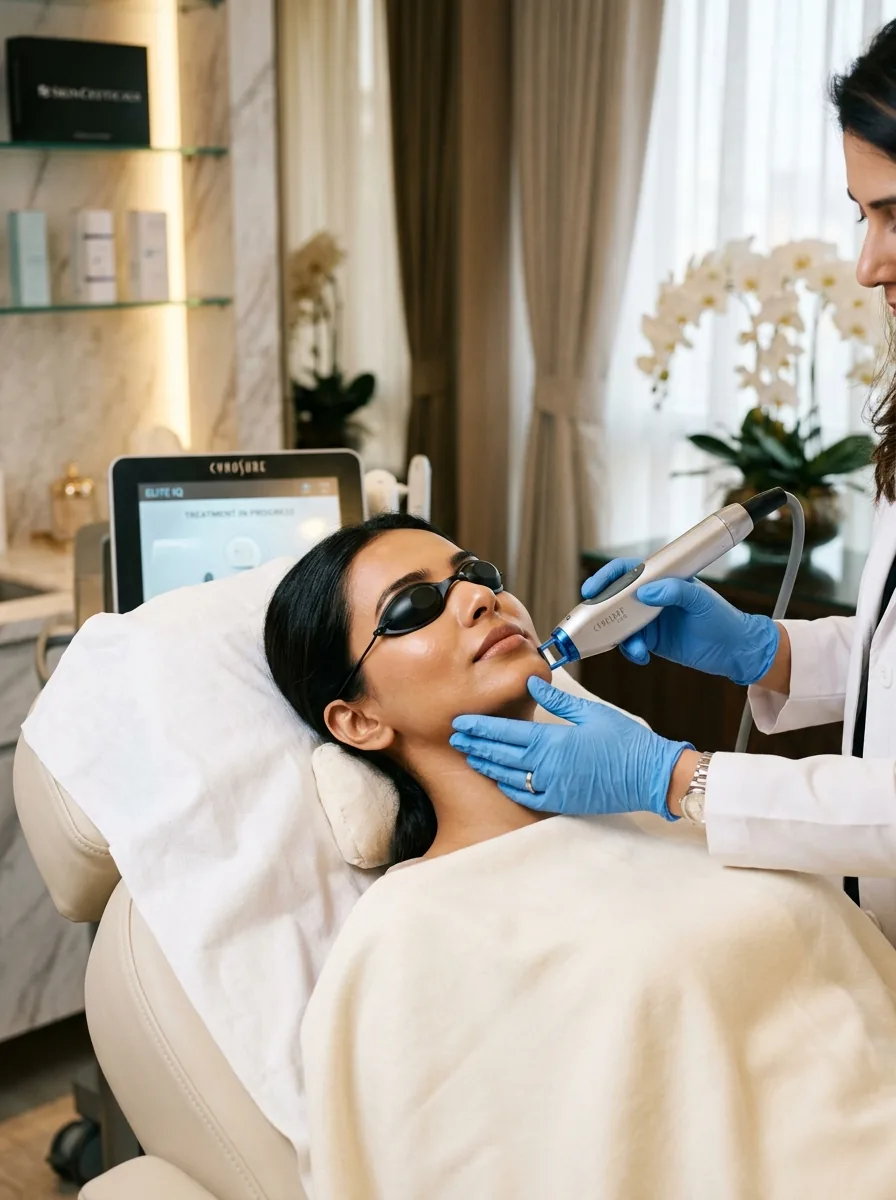
An objective look at how triple-wavelength diode lasers operate, their non-ionizing optical safety profile, and how integrated sapphire cooling maintains patient comfort.
Safety Profile and Radiation Clarification
Medical diode laser systems emit non-ionizing optical energy calibrated across specific wavelengths (755nm, 808nm, and 1064nm). This light penetrates a few millimeters beneath the skin surface to target melanin in hair follicular structures, carrying no ionizing radiation risk.
Procedural Comfort and Contact Cooling
Unlike older flashlamp systems that generated uncomfortable heat spikes, modern diode platforms incorporate continuous contact sapphire cooling. This maintains the epidermal temperature low throughout the pulse cycle, significantly enhancing procedural comfort.
Application Across Diverse Skin Phototypes
Wavelengths such as 808nm and 1064nm utilize calibrated pulse widths designed to safely pass epidermal melanin, allowing controlled hair reduction protocols for Indian skin phototypes (Fitzpatrick III to V).
Session Requirements and Hair Growth Biology
Hair follicles progress through cyclical phases: anagen (active growth), catagen (transition), and telogen (resting). Follicular thermal reduction occurs during the anagen phase. A structured series of 6 to 8 sessions is planned to intercept successive follicle growth cycles.
Questions About Laser Hair Removal?
Schedule a 1-on-1 consultation with Dr. Mahek Motwani at our Mulund West clinic.