
Acne Scar Remodeling Treatment
Targeted procedures to encourage collagen remodelling and reduce the depth of boxcar, rolling, ice-pick, and raised scars, directed by Dr. Mahek Motwani (25+ Years Clinical Expertise & Decade in Aesthetics).
Have active breakouts, pimples or post-acne dark spots?
Active acne is a separate medical condition requiring stabilization first.
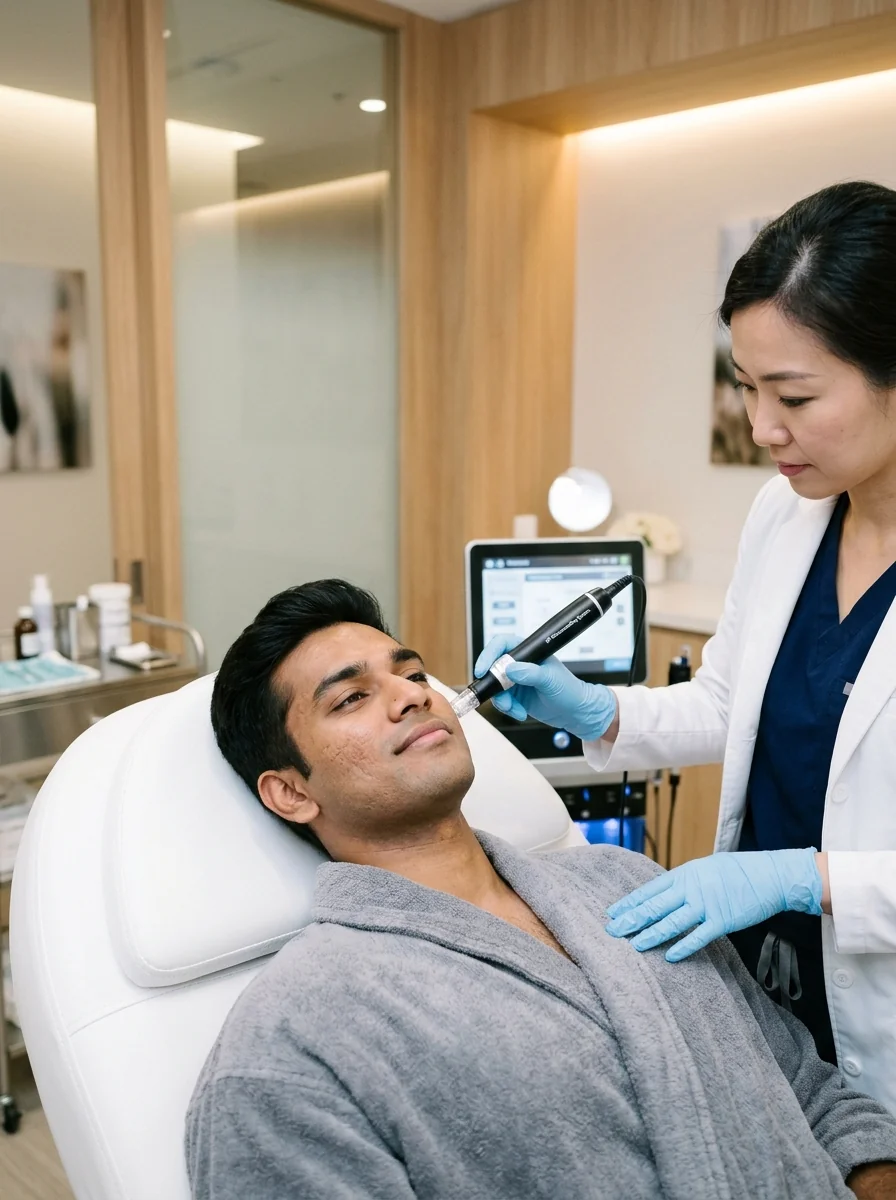
Understanding Acne Scars & Collagen Remodeling
Pitted atrophic, rolling, and icepick acne scars cannot be reversed with topical creams because fibrous tethering bands pull the skin downward. Effective remodeling requires a multi-modality approach: Nokor needle subcision to release deep fibrotic tethers, high-concentration TCA CROSS for focal icepick scar re-epithelialization, and fractional RF microneedling to induce neo-collagenesis across 3 to 5 sessions.
What are Acne Scars?
Acne scars are changes in the skin’s texture that can develop when acne-related inflammation affects collagen during the healing process. They may appear as depressed pits, rolling scars, boxcar scars or raised scars.
Acne Scar Treatment at The Pinnk Door Clinic
Treatment options depend on the type and severity of your scars and may include microneedling, radiofrequency microneedling, fractional laser resurfacing, subcision or TCA CROSS. These procedures encourage collagen remodelling, helping to reduce the appearance of scar depth and uneven texture while promoting smoother-looking skin over time. Treatment selection depends on your skin type, condition and individual suitability. Several sessions may be recommended to achieve the best possible results.
Unlike active acne which involves ongoing bacterial infection and inflammation, acne scars represent permanent alterations in dermal architecture. When deep inflammatory cysts or papules damage surrounding collagen, the skin may heal with tethered fibrotic strands, volume loss, or irregular scar tissue.
Because most patients present with mixed scar morphologies across different facial zones, monotherapy is rarely sufficient. A personalized multi-modality protocol is designed to address every layer: releasing fibrous tethering from underneath, tightening pore walls, and stimulating neocollagenesis at the surface.
Scar Types & Textural Concerns Treated:
Clinical Classification of Acne Scar Types
Narrow, steep V-shaped epithelial tracts resembling deep puncture marks, requiring focal high-strength trichloroacetic acid reconstruction.
Broad, undulating depressions anchored to underlying subcutaneous fascia by rigid fibrotic bands, elevated by physical untethering.
Round or oval depressions with sharp, vertical cliff-like walls, requiring fractional thermal remodeling to soften borders.
Thickened, elevated fibrous tissue resulting from excessive collagen accumulation during abnormal wound healing.
The Biological Timeline of Neocollagenesis
Dermal collagen remodeling is a staged physiological response. Fibroblast activation, elastin synthesis, and type I/III collagen reorganization develop continuously over 8 to 12 weeks after each session. Rather than temporary superficial plumping, this multi-modality approach produces progressive, enduring textural improvement.
In compliance with National Medical Commission (NMC) ethical regulations, acne scar revision aims to reduce scar depth, soften irregular margins, and improve skin contour. Complete 100% skin eradication is biologically unfeasible. Outcomes vary with scar age, tissue elasticity, and individual wound-healing biology.
The Clinical Process & Treatment Course
Scar Mapping & Morphological Assessment
Evaluation of each scar type (rolling, boxcar, ice-pick, raised) along with tissue tethering depth and skin phototype.
Subcision & Tether Release
Specialized micro-cannula subcision physically releases the rigid fibrotic bands pulling rolling and boxcar scars downward.
TCA CROSS & Energy Collagen Remodeling
High-strength TCA CROSS focal application for deep ice-pick scars, combined with RF microneedling or fractional resurfacing.
Progressive Dermal Remodeling & Follow-Up
Collagen remodeling matures over 8 to 12 weeks per session, with gradual lifting of scar depressions and texture smoothing.
Key Aspects of Scar Remodeling
Deep Collagen Induction
Encourages natural collagen remodelling to level depressed scar tissue and restore smoother contours.
Multi-Modality Precision
Subcision, RF microneedling, fractional laser, and TCA CROSS matched specifically to each scar morphology.
Safe for Indian Phototypes
Parameters strictly calibrated under Dr. Mahek's medical guidance to prevent post-treatment hyperpigmentation.
Subcision Fibrotic Release
Frees anchored rolling scars from deep subcutaneous fascia, allowing new collagen to fill the deficit.
Overall Skin Refinement
Refines pore architecture and surface irregularities alongside structural scar correction.
Structured Session Planning
Several sessions planned thoughtfully with realistic, transparent timelines discussed upfront.
Acne Scar Remodeling Modalities
Subcision (Scar Tether Release)
Releases deep fibrotic bands per session
Radiofrequency / Medical Microneedling
Collagen remodelling & dermal tightening
TCA CROSS (Focal Chemical Reconstruction)
Targeted protocol for deep ice-pick & boxcar scars
Fractional Laser Resurfacing
Surface smoothing & epidermal texture refinement
Treatment selection depends on your skin type, condition and individual suitability. Several sessions may be recommended to achieve the best possible results.
Book consultation for personalised planFrequently Asked Questions (Acne Scar FAQ)
Book Scar Assessment
Under Dr. Mahek Motwani's care in Mulund West